

Endpoint Detection and Response
What is EDR?
Endpoint detection and response (EDR) is a form of endpoint protection that uses data collected from endpoint devices to understand how cyber threats behave and how organizations respond to them. It is a system that gathers and analyses security-threat-related information from computer workstations and other endpoints in order to find security breaches the moment they occur and make it easy to respond quickly to discovered or potential threats. In this article you will learn what EDR is, what kinds of threats EDR solutions can detect, and what to look for when evaluating EDR tools.
The primary functions of an EDR security system:
- Monitoring and collecting activity data from endpoints that might indicate a threat
- Analysing that data to identify threat patterns
- Responding automatically to eliminate threats
Why does it matter?
Endpoint detection and response has become a critical component of any endpoint security solution, because there is no better way to detect an attack than to monitor the target environment under attack — and the telemetry an EDR platform collects allows for full prioritization and investigation.
Most importantly, traditional endpoint security tools cannot detect or neutralize the advanced threats that slip past them. EDR picks up where those traditional endpoint security solutions leave off. Threat detection analytics and automated response capabilities can identify and contain potential threats that have breached the network perimeter — often without human intervention — before they cause serious damage. EDR also provides tools that security teams can use to discover, investigate and prevent suspicious and emerging threats on their own.
How does it work?
EDR security solutions record the activity and events occurring on endpoints and across all workloads, giving security teams the visibility they need to surface events that would otherwise remain invisible. An EDR solution has to provide continuous, comprehensive visibility into what is happening on endpoints in real time.
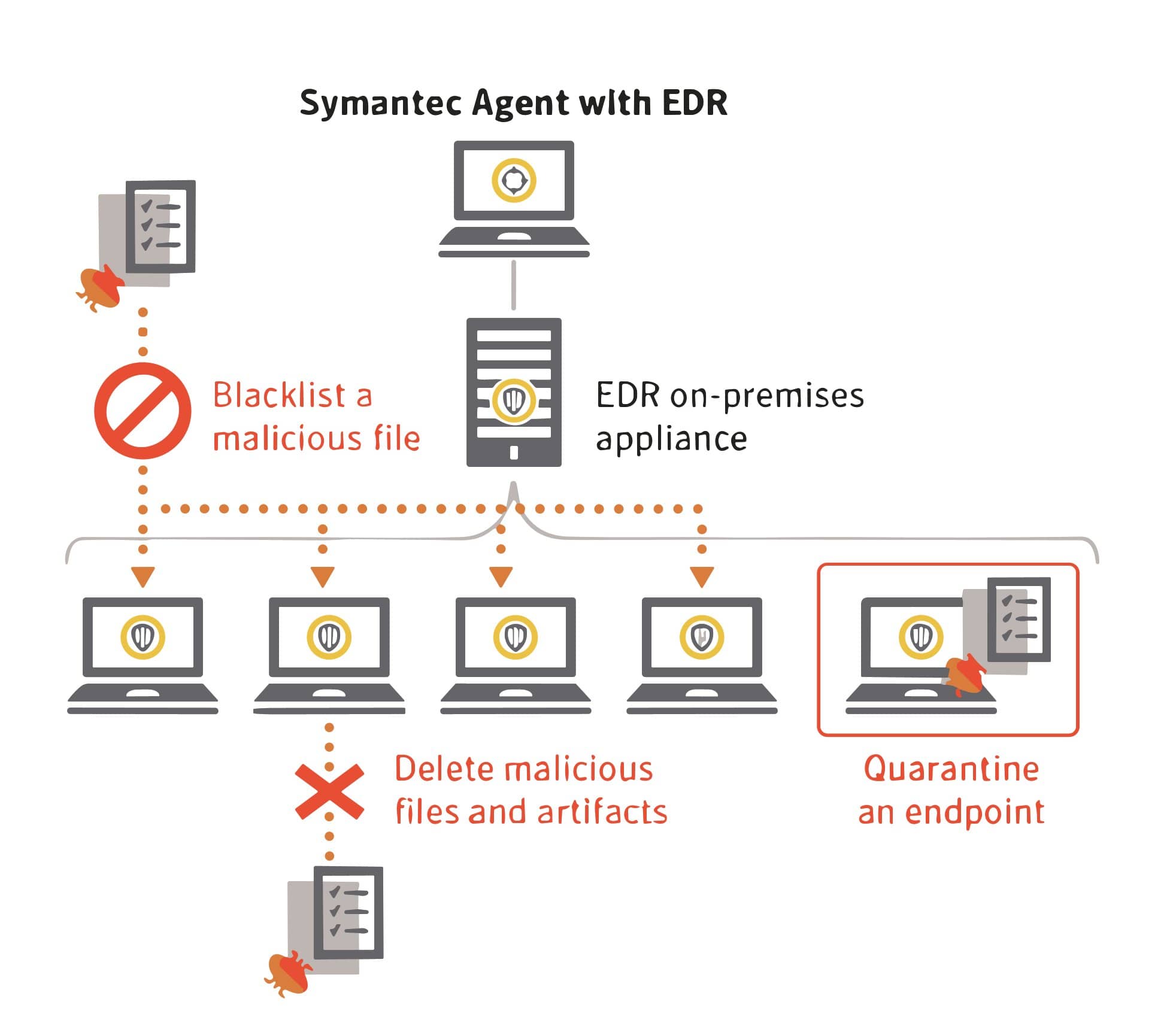
An EDR tool should offer advanced threat detection, investigation and response capabilities, including incident data search and investigation, alert prioritization, suspicious activity validation, threat hunting, and the detection and containment of malicious activity.
Incident prioritization: an EDR automatically flags potentially suspicious or malicious events and brings them in front of a security analyst.
Threat hunting: EDR should support threat hunting activity so that security analysts can search proactively for possible intrusions.
Data collection: it should use as much data as possible in order to make informed decisions about potential threats.
Key benefits
Improved visibility: EDR security solutions perform continuous data collection and analysis and report to a single central system. That gives a security team full visibility into the state of the network's endpoints from one console.
Faster investigations: EDR solutions are designed to automate data collection and processing along with certain response activities. This lets a security team obtain context about a potential security incident quickly and take rapid steps to remediate it.
Remediation automation: EDR solutions can carry out certain incident response activities automatically based on predefined rules. That allows them to block or quickly remediate specific incidents and reduces the burden on security analysts.
Contextual threat hunting: the continuous data collection and analysis of EDR solutions provides in-depth visibility into the state of an endpoint. That allows threat hunters to identify and investigate potential signs of an existing infection.
Conclusion
Through continuous endpoint monitoring and rigorous data analysis, businesses can better understand how one threat or another affects an endpoint and the mechanisms by which it spreads through a network. Rather than remediating threats unprepared, organizations can use the insights gained through EDR tools to harden their security against future attacks and reduce dwell time in the event of an infection.